Rejuran before and after: what changes, and in what order
A Seoul dermatologist explains what Rejuran realistically changes, in what order, and how we keep the injection safe — without a single marketing gallery.

What people actually mean when they search "Rejuran before and after"
Almost everyone who messages me about Rejuran before and after is asking the same two questions underneath: *will anything visibly change on my face, and how do I know this is safe?* That is a fair thing to want before you spend money on an injectable in another country.
I am going to answer it the way I would in my consultation room in Apgujeong. Not with a gallery — we publish none, and I will explain why below — but with what Rejuran is designed to change, the order in which those changes tend to appear, and the questions that separate a safe injection from a careless one.
If you have already read our general guide, Rejuran in Seoul: what it does, how we use it at Wells, this article is the safety-and-expectations companion to it.
Why we don't publish a Rejuran results gallery
Wells does not publish patient result galleries or star ratings anywhere on this site. That is a deliberate policy, and I would rather explain it than quietly work around it.
Two faces with the same complaint rarely have the same skin. Lighting, angle, makeup, hydration on the day and the camera itself change a picture far more than most people realise. An image set proves that one person's skin looked different on two days. It does not tell you what your skin will do — and it is not a substitute for a dermatologist examining you.
So instead of showing you someone else's face, I would rather look at yours. Send a straight-on image taken in daylight, no makeup, and tell me what bothers you. You will get an honest opinion on whether Rejuran is even the right tool.
That policy also means nobody here has an incentive to promise you a dramatic change. The plan you get is the plan I think your skin needs.
Send one daylight image of the area that bothers you and your travel dates. A dermatologist replies with whether Rejuran fits, and what to expect realistically.
Send a photo, get a dermatologist's opinionWhat Rejuran is designed to change — and what it is not
Rejuran is a skin booster based on polynucleotide (PN), a salmon-derived molecule. In the formula we inject, Rejuran HB+, the polynucleotide works on the skin's internal environment and restores its structure: elasticity in both the epidermis and dermis increases, fine lines and texture smooth out, and the oil–moisture balance normalises so skin looks hydrated rather than shiny. Added hyaluronic acid strengthens that hydration.
Read that list again, because it explains every realistic Rejuran before and after expectation. It is a skin-quality treatment. It is not a filler and it is not a toxin — it does not add volume and it does not relax a muscle.
- A good match: rough texture, enlarged pores, fine lines around the eyes and cheeks, dull or dehydrated skin that needs regeneration.
- A partial match: deep wrinkles or sagging. Rejuran improves the skin over them, but the lift itself comes from a different category of treatment.
- Not the right tool: hollows that need volume. That is a premium filler conversation, and I would rather tell you that at the consultation.
The most common correction I make on WhatsApp is not about Rejuran itself — it is people expecting a booster to lift the jawline. If that is your main concern, we should be discussing lifting, not a skin booster.
In what order do changes appear across a Rejuran course?
For Rejuran HB+ we recommend four sessions at two-to-three week intervals. That interval is the honest frame for any Rejuran before and after conversation: this is a course, not a single event, and skin generally responds to regenerative treatments gradually rather than overnight.
What I tell patients to watch for
Because the treatment works on the skin's internal environment, the things people notice first are usually the quiet ones — how makeup sits, how the skin feels to the touch, whether it still looks tired under office lighting in the afternoon. Texture and hydration are typically the earliest changes people report to me; fine lines and pore appearance are the slower, more structural part, which is exactly why we space sessions and repeat them.
I deliberately avoid quoting a week number here. Individual results vary, healing speed varies with age and skin condition, and I will not put a timeline on your face that I have not examined. At the consultation I tell you what I expect for *your* skin and what I do not.
Rejuran Healer vs Rejuran HB+: the formula we inject, and why
When people compare Rejuran before and after accounts online, they are often comparing two different products. The original formula most people have heard of is Rejuran Healer. At Wells we inject Rejuran HB+, which combines the polynucleotide with hyaluronic acid and lidocaine.
The hyaluronic acid is about hydration. The lidocaine is about comfort, and that difference is measurable: in the data we rely on, lidocaine in the HB+ formula cut post-injection pain by an average of 53% on the VAS scale compared with Rejuran Healer.
| Rejuran Healer | Rejuran HB+ | |
|---|---|---|
| Active ingredient | Polynucleotide (PN) | Polynucleotide (PN) |
| Hyaluronic acid | — | Added, for hydration |
| Lidocaine | — | In the formula — 53% less post-injection pain on average (VAS) |
| Course we recommend | — | Four sessions at 2–3 week intervals |
Comfort is not a luxury detail in a course treatment. A first session that hurt is a second and third session people quietly skip — and a half-finished course is the most common reason someone feels their Rejuran did nothing. Full details are on the Rejuran HB+ skin booster page.
How we keep a Rejuran injection safe
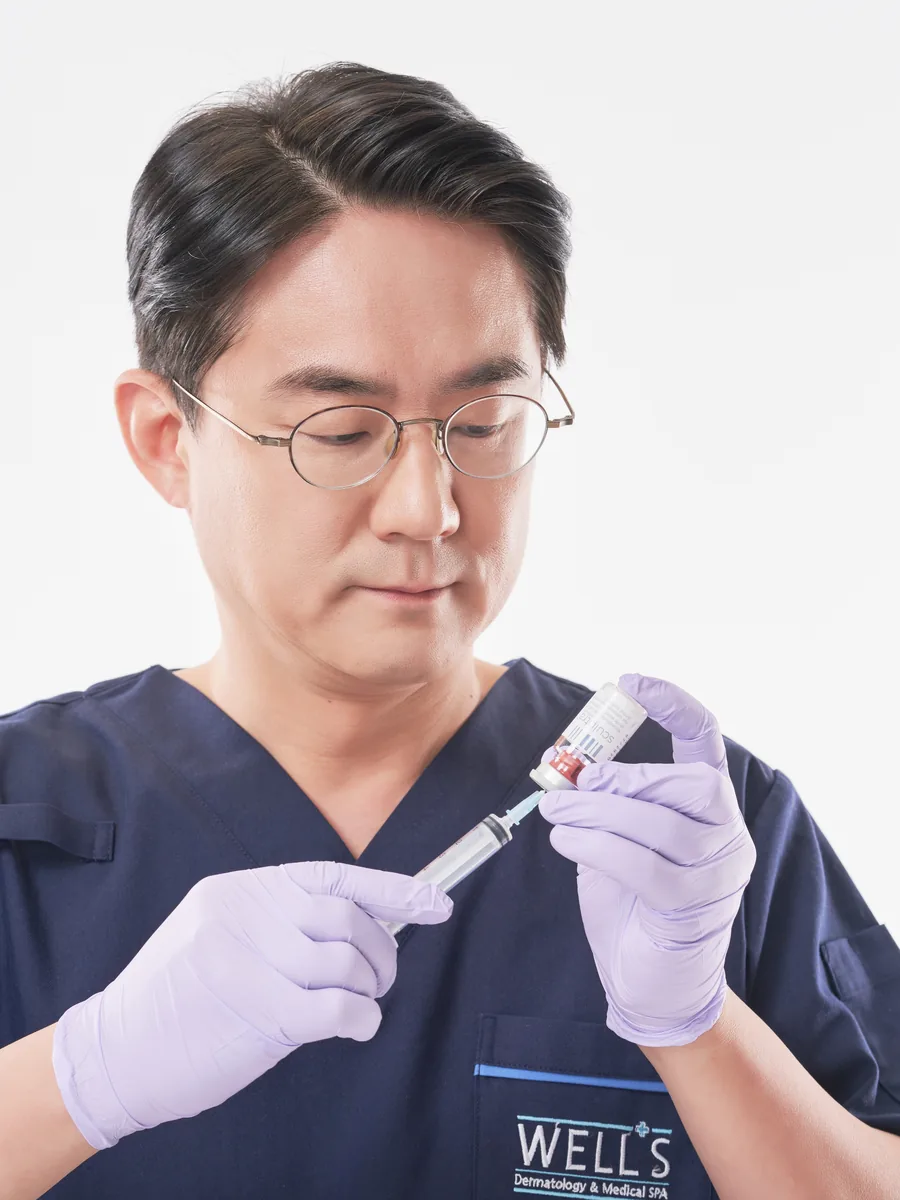
Rejuran is an injection, and every injection at Wells is placed by a board-certified dermatologist — consultation, diagnosis and treatment, start to finish, not handed to a nurse or an aesthetician. Where a cannula is the safer instrument, we use a cannula rather than a standard needle, because it minimises the vessel-damage risk.
My own background is dermatology at Seoul National University Hospital, where I completed my residency and board certification, took my Ph.D. in dermatology and later served as a clinical instructor and adjunct professor. I mention it for one reason only: in Korea, "skin clinic" and "dermatologist" are not the same thing, and you are entitled to know which one is holding the syringe.
Wells has been in Apgujeong since 2008 and is certified by the Korean Dermatological Association — a mark issued only to dermatologist-run clinics, displayed at our entrance. Genuine product and quantity are guaranteed for what we inject.
Red flags worth checking at any clinic
- Who performs the injection? If nobody will name a board-certified dermatologist, stop there.
- Is the exact product and volume written down before you agree? Ours is: Rejuran HB+ 3 cc, and 3 cc of skin botox in the combined protocol.
- Are possible side effects explained to you in person, in a language you understand, before anything starts?
- Are you being sold a package before anyone has examined your skin? Diagnosis should come first.
- Does the clinic promise a guaranteed outcome? No honest doctor can. Individual results vary and side effects are possible with any injectable.
Not sure whether the clinic you found answers those five questions? Ask us the same ones first — you will get a straight reply in English before you commit to anything.
Ask a dermatologist on WhatsAppRejuran in Korea: what a visitor pays, and how sessions fit a trip
Prices at Wells are listed in Korean won, VAT excluded, and the dermatologist confirms the plan and the final price at the consultation before anything starts.
Our signature protocol is Rejuran Tox: Rejuran HB+ 3 cc for regeneration, moisture and elasticity underneath, plus skin botox 3 cc — micro-dosed botulinum toxin across the surface to smooth fine lines, refine pores and improve sebum and texture — in one visit.
| Option | Contents | Price |
|---|---|---|
| Nabota (Korean) | Rejuran HB+ 3 cc + Nabota 3 cc | ₩913,000 (VAT excluded) |
| Allergan | Rejuran HB+ 3 cc + Allergan 3 cc | ₩1,089,000 (VAT excluded) |
For Rejuran HB+ on its own, the price is confirmed at your consultation — message us with your concern and we will quote it before you travel.
The travel constraint is real: four sessions at two-to-three week intervals do not fit a long weekend. What we do instead is plan around your dates — tell us your flight dates on WhatsApp and I will advise on timing, and on what a shorter visit can and cannot reasonably achieve.
We are on the 8th floor of the Apgujeong Building, 842 Nonhyeon-ro, Gangnam-gu — Subway Line 3 to Apgujeong Station, Exit 3, about five minutes on foot. Open Monday to Friday 10:00–20:00 and Saturday 10:00–17:00, lunch 13:00–14:00, closed Sundays and Korean public holidays. Consultations are available in English.
Send your own image and your dates — you'll get a dermatologist's read, not a gallery
Tell us what bothers you about your skin and when you'll be in Seoul. A board-certified dermatologist replies in English with whether Rejuran HB+ or Rejuran Tox fits, the listed price, and available times. Individual results vary and side effects are possible — that is exactly why every plan starts with an examination.
Message the clinic on WhatsAppReplies on WhatsApp · prices in KRW, VAT excludedBefore you message us
Why doesn't Wells show Rejuran result images?
We do not publish patient result galleries or ratings anywhere on this site. Lighting, angle and makeup change an image more than most people expect, and someone else's skin tells you nothing reliable about yours. Send us your own image instead and a dermatologist will give you an opinion.
How many Rejuran sessions before anything changes?
For Rejuran HB+ we recommend four sessions at 2–3 week intervals. Changes develop gradually rather than all at once, and individual results vary — the dermatologist tells you what to expect for your skin at the consultation.
Is Rejuran HB+ different from Rejuran Healer?
Yes. Rejuran HB+ adds hyaluronic acid for hydration and lidocaine for comfort. In the data we rely on, the lidocaine cut post-injection pain by an average of 53% on the VAS scale compared with Rejuran Healer. Wells injects HB+.
Does Rejuran hurt, and are side effects possible?
The HB+ formula contains lidocaine, which is one reason we use it. Individual sensitivity varies. Side effects are possible with any injectable, which is why every treatment here starts with a dermatologist consultation where they are explained to you in person.
How much does Rejuran cost in Seoul at Wells?
Rejuran Tox — Rejuran HB+ 3 cc plus skin botox 3 cc — is ₩913,000 (VAT excluded) with Nabota or ₩1,089,000 (VAT excluded) with Allergan, per session. Rejuran HB+ on its own is quoted at your consultation.
Can I fit a Rejuran course into a short trip to Korea?
A full course of four sessions at 2–3 week intervals does not fit a long weekend. Tell us your flight dates on WhatsApp and the dermatologist will advise on timing and what a shorter visit can realistically do.
Results and recovery vary by individual. Every treatment carries possible side effects, which are explained at the consultation. Prices are in Korean won, VAT excluded, and confirmed at your consultation. This article is general information from the clinic, not a diagnosis.
Dr. Won Woo Choi
- Board-certified dermatologist, Seoul National University Hospital
- Residency & board certification in dermatology, Seoul National University Hospital
- Ph.D. in Dermatology, Seoul National University
- Former clinical instructor, Seoul National University Hospital
- Adjunct professor, Department of Dermatology, Seoul National University Hospital